

“The Man Who Saw Heaven”- Portraying Joseph Smith

Me singing as Joseph Smith in “The Man Who Saw Heaven,” or possibly yelling, or belching, November 2025

Nearly 22 years ago, my senior year in high school, I fell into a unique and life enhancing opportunity.

The Anchorage Alaska temple of the Church of Jesus Christ of Latter-day Saints, was being re-dedicated. This meant that there was a desire for the local members of the church to put on some kind of cultural production in celebration. The prophet at the time, Gordon B. Hinckley, would be attending this cultural production before the re-dedication ceremony.

An amazingly talented local church member had started writing a musical about the 1890’s Alaska gold rush, and it was decided that this musical would be adapted into the cultural celebration for the temple. Members of the church at that time were asked to come and participate in this musical and begin rehearsals.

At the same time this was happening, I was actively in rehearsals for my high school musical, playing the character of Rolf in “The Sound of Music” (a very fun part to play!). I decided to audition for this temple musical as well and was offered the lead role. Unable to rehearse two musicals at the same time, I ended up quitting The Sound of Music and committed to the temple musical which was called “In the Shadow of the Mountain.”

Every single one of my Mormon friends also participated in this musical, and I made so many new friends because of this musical. It was so much fun and an incredible bonding experience that fostered and produced lifelong friendships. After a few months of rehearsals, it all came together and we performed in front of the prophet. I even kissed a girl in front of the prophet! The characters we played were fictional, but the stories we shared were real. It an was emotional, impactful, joyful and incredible experience. As a young man about to graduate, attend BYU in the fall, and serve a 2-year mission for the church, it fueled me and kept me focused and driven. It inspired me to be a better person. It was what I needed at that time in my life to get me through the challenges I was about to face.
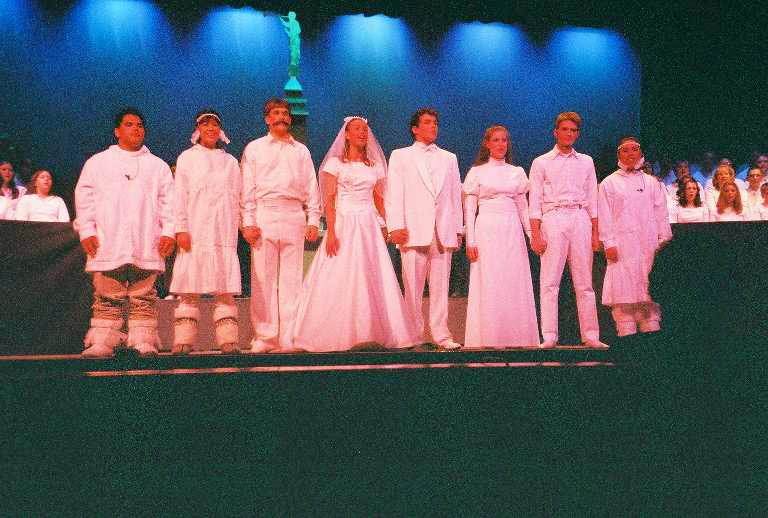
Ending pose of “In the Shadow of the Mountain,” February 2004. I’m second from the right.

Fast forward 2 decades and interestingly enough I found myself in a very similar situation, playing the lead role in an original musical production. Only this time, the character I was playing was a real person.

Joseph Smith Jr.

The musical was called “The Man Who Saw Heaven.” We just wrapped our last show this past weekend. Original music, inspiring messages, and a story based on the life of the first prophet of The Church of Jesus Christ of Latter-day Saints.

As soon as we started recording music and rehearsing, I turned back into that 18-year old boy. That boy had no idea that over the next 20 years of his life he would have some amazing opportunities to perform. Many of those opportunities came from his time attending BYU as he traveled abroad with the International Folk Dance Ensemble, and sang in front of TV cameras with BYU Vocal Point.

Performing a clogging dance number in Beijing, China with the BYU Folk Dance Ensemble, May 2009. That guy in the center of the photo, skinny skeleton neck, that’s me.
Performing with BYU Vocal Point on NBC’s “The Sing-Off,” September 2011. I’m on the far right.

He would also have 20 years of life experience, some of it joyous and happy as he would marry and start a family, raise children, and find different career opportunities, some of it painful and heartbreaking as he would… marry and start a family, raise children, and find different career opportunities…

Family photos, July 2024. Yes we always walk in the middle of the road holding hands, smiling and happy.

The point is that the (recently) 40 year old man I am today is a much different person than that 18 year old boy. VERY different. But those feelings, those emotional, impactful, joyful and incredible feelings I felt back then, while they’re the same feelings, it’s like they’ve been bitten by a radioactive sentimental super spider and enhanced to meta-human emotional capacities.

It doesn’t take much these days for my emotions to pop out of my eyes and nose in the form of tears and snot, whether it’s uncontrollable laughter from a hilarious cast constantly cracking jokes, or channeling the painful thoughts of recently turning 40 years old in an intense emotional scene on stage as snot droops uncontrollably all over my hands and face.

Who knew that performing on a stage at a church building in my own backyard could be a more emotionally impactful experience than performing for foreign audiences and on reality TV shows.

Since I came in on this project, I’ve been considering how to portray, and how I feel about portraying Joseph Smith Jr. Before I do I think it’s important to note that I do not know everything about Joseph Smith or church history. But I have read, and studied, quite a bit about him. Over the years I’ve read about his life from many different sources, some very faithful, and some not so much. I’ve read Rough Stone RollingNo Man Knows My HistoryRemembering JosephThe CES Letter, and many more. I’ve listened to countless podcasts of people talking about him, again from all different perspectives. My focus here is not to dive into either side of any debate about who Joseph Smith was or was not. I simply want to share what my experience was portraying this man on stage as part of a theatrical musical production.

How do I portray him?

I decided I would take my cues from the inspiring music, the script, and the message of the show. Joseph Smith, the prophet of God, and a man, called to restore Christ’s church back to the earth. That’s the character I tried to portray. He shared his experiences with the world, and I wanted to help share his story from his faithful perspective. Say what you will about him, but he was earnest, sincere, and did everything he could to fulfill the calling he felt that God placed upon him. I hope I did that justice.

How do I feel about portraying him?

This was a little more complex for me. On one end, it’s just a character that I’m playing. The joy of being a nobody amateur actor is I don’t have to agree or disagree with the character I’m playing. I just get to play a role. I did a lot of plays back in high school and I played good guys and bad guys. Bad guys were often more fun to play. Not because I personally agreed with my character, but because it was fun to play someone so different than myself. How I feel about a character should be irrelevant.

But on the other end, especially in this case, the character of Joseph Smith, a real person who actually lived, and a person that is so engrained in my own religious upbringing, it was impossible for me to not have complex feelings about it. I understand the issues people have with him. I do. I get it. I also understand the faith people have in him as God’s prophet. I can see both sides and everywhere in between, and this effects me personally. How could it not?

But herein lies the message of the show. And for me, this was extremely helpful. It comes in the last two songs of the musical.

The first isn’t actually a song, but a speech entitled “The Living Christ,” delivered passionately by the actor playing the character of Brigham Young. In his speech, he asks:

“If there is something in your life that shakes your faith, then what? Do you look up to heaven and curse God? Do you throw away all the light that has ever illuminated your life? Or do you hold even faster to the little that you do know?”

The second and very last song of the musical is called “This I know.” The message of the song is that there are so many questions surrounding the life of Joseph Smith, and some of those questions might not ever be answered, even today, but despite those questions, the people that knew him and were next to him, felt heaven in his presence.

There is a lot that I don’t know. And my faith has definitely been shaken many times over the years for a variety of reasons. I have no intention of throwing away any light that has illuminated my life, even though it has often felt quite dark. I hope to take as many opportunities as possible to enhance light in my life. No matter what I believe or don’t believe, know or don’t know.

For me, this musical was an opportunity to enhance light in my life. I wasn’t alive back then. I can’t know for sure what happened or didn’t happen. I was never physically next to Joseph Smith. I can’t declare that I felt heaven in his presence. But if I’m lucky enough to get a chance to portray him, share his story, and the stories of those that did live back then and were in his presence, then that sounds like an opportunity to share some light.

And that light that those people felt, and shared, has to count for something.

Me portraying Joseph singing with Emma and some members of “The Man Who Saw Heaven” cast staring at us, November 2025

Amazing Grace

“…there is no Divine vending machine. Our good works are not tallied up on some giant heavenly whiteboard earning us one more brick on our heavenly mansion.”

Photo by Greg Weaver on Unsplash

What does “Grace” mean to you?

The concept of grace has been on my mind a lot lately.

I recently finished reading a book by Adam S. Miller called “Original Grace.” I absolutely love this book. It has changed and expanded my perception on the idea of God’s grace and how it effects me personally.

Now I’m no religious scholar, and there’s quite a bit in that book that I’m going to have to read again to better understand. But after one read, there are just some thoughts about the topic of grace that I need to get out.

My goal in writing this is not to lay out a doctrinal discourse of the conceptualization of grace, and it also may not align with traditional views of grace that are generally understood and believed by others. It’s just my thoughts. My feelings. Grace as I understand it as of today according to the book of Mikey. A book that’s constantly being edited.

Prayer

I think as I’ve gotten older, my concept of God and my relationship with Him has changed.

When I was little, I sang from a very young age one of my favorite songs “I Am A Child of God.” I understood that God was my Father, and everyone here on earth are my brothers and sisters, also children of God. I prayed to Him at night, at meals, and whenever I felt sad, grateful, or in need of something.

The idea of prayer was a simple concept for me in my youth. I can talk to God, like I would talk to a friend. I could thank Him for the many things in my life I had to be grateful for. I could ask Him for help with something I was struggling with. I was taught that He would not only listen to my prayers, but that I could receive comfort and even answers to my prayers.

But this is where things got a little more difficult for me. Like it or not, every time I prayed, it felt like a one-sided conversation. Sure I would get feelings of comfort or joy and happiness, and I would take those feelings and interpret them as I felt in the moment, and that was helpful for me. But as far as words spoken back to me, something clear and easy to understand, something like an actual conversation, this never happened.

Now every Sunday and every time I read the scriptures by myself or with my family, there is story after story of God talking to people. Usually Biblical prophets, but not always. Full on conversations with specific commandments, instructions, and directions. I also grew up hearing stories of church leaders, people around me, and people that I knew talking about how they would get answers to prayers. They would share an experience or a struggle they were having, talk about faith and prayer and obedience to commandments, and the story would end with “I knew what God wanted me to do, and I did it, and it was an answer to a prayer.” Or maybe there was a twist of some kind like “I kept praying for X, I strived harder to keep the commandments, read scriptures, go to church, study, etc, and God answered my prayer in His own time and in a different way than I expected, and I didn’t realize it until later.”

Prayer is a very personal, sacred, and special thing for me and for anyone who engages in it. It’s not my place to judge someone else’s experience from prayer. But that doesn’t mean that hearing these kind of stories, both from scriptures and from people over the years, didn’t have an effect on me.

Transactional God

This effect, especially in my youth but even up until recently in my life, deeply embedded this idea that God was a transactional God. Like a vending machine that you walked up to, inserted your tokens of obedience and adherence to God’s laws, and in return you received a promised blessing. The scriptures especially are full of stories and phrases that encourage obedience and promise blessings. Over and over and over again.

Don’t get me wrong, I fully believe that God can and will bless you in your life. He has certainly blessed me more times than I can count.

But there is a flip side to this belief of a transactional God. If obedience to God’s commandments = promised blessings, than naturally disobedience to God’s commandments = punishment. Maybe that’s too harsh, how about failure to obey God’s commandments = no blessings. You don’t pay the token, you ain’t gettin’ nothing!

I’m oversimplifying, I know, but it’s still a concept that I was taught and has been engrained in me for my entire life. And the result is a relationship with God that became transactional.

If I remembered to pray twice a day, read scriptures every day, go to church every Sunday, and keep every other commandment as best I could, any blessing I felt I received, I attributed to my diligence and my effort and God was fulfilling his promise. If I forgot to pray, or read scriptures, or missed church, or failed to keep some commandment, and something bad then happened in my life, I would immediately chalk that up to deserved punishment for not paying my obedience token.

It’s a simple concept. Easy to understand, easy to feel good about myself for the good choices I make and the nice blessings I receive, and easy to justify the reasons why bad things would happen to me if I disobeyed something.

It’s also, I now believe, completely false.

Here’s a challenge that I think every God-fearing faith-filled person can relate to: You’re struggling with something and for whatever reason you’re in dire need of blessings from God. So you follow the formula. Church. Scriptures. Study. Prayer. Service. Tithing. You grind and focus and commit yourself. You are loaded with obedience tokens, you’re feeding that vending machine. Maybe you have a specific blessing you’re in need of or maybe you don’t. Maybe you’re happy to let God bless you in some way that you can see and understand and know that all this diligence, all this effort, is being rewarded cuz MAN after all this work, you are EARNING IT! ANNNNNDDDD….

Nothing.

Or maybe worse than nothing. Maybe despite your efforts, something horrible happens in your life. Something awful. Something unbearable. And now, you’re confused. You’re frustrated. You interpret all these horrible things as punishments. God is punishing you! You’re diligently paying your obedience tokens and the vending machine must be broken! The rug is pulled out from under you. You feel you don’t receive the blessing you deserve.

I don’t know about you, but when this happens to me, I find myself responding one of 2 ways: 1. Get angry at God and feel like giving up or 2. Frustrate myself into even more obedience, determined to figure out what I must be doing wrong and fix it to stop God’s punishment. Like a crazed conspiracy theorist psychopath attributing meaning and significance to every single action in my life until I spin down this whirlpool of sadness and drown in my own depression because there must be something horribly wrong with me, and I can’t figure it out. I can’t solve the puzzle. I feel undeserving, alone, and unworthy.

Worthiness

A quick side note on worthiness. I may rub some people the wrong way by saying this, but I do not like the word “worthy” or “worthiness.” It’s used all too often in church. It’s thrown around in talks, Sunday school lessons, temple prep classes, etc. Your interview for your temple recommend is even referred to as a “worthiness” interview.

I feel that the word carries with it a negative connotation and weight that results in people constantly feeling that they aren’t “worthy.” Worthy for blessings. Worthy to go to the temple or church. Worthy to get answers to prayers. Worthy of God’s love. As if God’s measurement of love for His children was directly correlated to our own worth.

And who judges my worth? Who can talk to me and conclude if I’m worthy or not?

That’s easy: Nobody.

Only God.

I think it would be a positive shift to completely remove the word “worthy” from common church vernacular. There are other words like “eligible” or “qualify” that convey similar meaning but leave off the spiritual and emotional weight and gravity of personal worth.

It’s this idea, though, in the context of a transactional God, that we can all too often feel unworthy. We are checking all the boxes to be worthy and when we don’t receive the blessings we feel we deserve, we sorrow in our own worthlessness.

The Prodigal Son

I LOVE the parable of the Prodigal Son. I think it is the most important story for understanding God’s love for his children. In Adam S. Miller’s book he goes into this parable in great detail, and expands upon it’s meaning in a way I had never understood before.

Now I’ll be the first to admit that for many years, this parable made no sense to me. One son squanders his inheritance, looses everything, falls off the deep end and comes back crawling to his father only to be embraced and celebrated? They throw a big party for him! But the person I related to was the other brother, who’s like “What the heck, dad! I’ve been here the whole time, I made all the good choices, and I never got any party! What gives?” Honestly that’s probably how I would have felt! Both sons felt they didn’t get what they deserved, based off their choices and actions.

Under the concept of a transactional God, this parable makes no sense. One son squanders his obedience tokens, but get blessed by his father anyways. One son paid his obedience tokens, but never got that kind of blessing he felt he deserved.

And it’s this parable that perfectly teaches me that God is not, in fact, a transactional God.

God’s Grace

God, our Father, is a God of grace. It is only with this understanding that I can start to comprehend the parable of the Prodigal son. It’s the only thing that explains it. And it’s written so beautifully. When the father sees his son returning, he RUNS to him! He literally could not contain his love! He had to get to him as soon as possible, and he fell upon him and kissed and embraced him.

There are some lessons that I can only fully understand as a parent. And that’s one of them. Because, if that were my child, I would do exactly the same thing.

God’s grace is not earned. It’s given freely, no strings attached. No conditions of obedience. No holding it back until I deserve it. No weighing of obedience against my worthiness for His divine love. The scale of undeserving, unrelenting, heavenly love is already tipped, and no amount of obedience or disobedience will change it.

So what does this mean for me? Well, it means I can 1. stop being angry at God and 2. stop being a crazed conspiracy theorist psychopath when all hell brakes loose on my life. Life is a mortal experience, and mortal things will happen to me. Yes, bad things are going to happen, and it’s not a direct result of anything I’ve done. And on the flip side, good things are going to happen to me, and it may or may not be God deciding to bless me. That’s completely up to Him and if I’m paying attention to receive it.

Most of my life, I never really understood God’s grace. My understanding of God’s grace came from the Book of Mormon, 2nd Nephi 25:23 “…it is by grace that we are saved, after all we can do.”

In Adam S. Miller’s book, he amends this. A better interpretation of this passage would be “…it is by grace that we are saved, despite all we can do.”

I actually think Ephesians 2:8-9 says it best: “For by grace are ye saved through faith; and that not of yourselves: it is the gift of God: Not of works…”

In other words, there is no Divine vending machine. Our good works are not tallied up on some giant heavenly whiteboard earning us one more brick on our heavenly mansion. Obedience tokens carry no currency value when it comes to God’s grace. You can earn all the faith dollars in the world, or be completely broke, and God’s love and grace for you will be exactly the same.

What an amazing GIFT it is.

In Adam S. Miller’s book he goes into great detail about how God’s grace is connected to creation, and how our own role in creation of children and raising them helps us to understand, appreciate, and internalize this idea of grace for those we love.

This idea speaks to me. This concept of grace for children, especially my own children, makes sense. I know this because I know how I feel about my own children. I often tell them when I kiss them goodnight in their beds, “I love you NM-Dub” short for “NMW” short for “No Matter What.” And it’s true. There is absolutely nothing they could do to cause me to not love them. It’s just simply never going to happen. Even if they get mad at me, ignore me, make bad choices, run away from me, never talk to me, or scream at me how much they hate me, I’ll still love them.

My children teach me what it feels like to be a father. This in turn teaches me how my Heavenly Father must feel towards me. And if it’s anything like I feel about my kids, well… it’s an extremely comforting thought.

Adam S. Miller even ends his book quoting another author, Stephen Robinson (Believing Christ) who said: “Everything you’ll ever need to know about grace can be learned in the following way: Hold a baby in your arms, perhaps while the family is out, perhaps in a chair, perhaps your own son or daughter, what do you feel? An absolute love. What has the baby done to deserve your love? Nothing. What would you sacrifice for that baby? Everything. This is God. This is grace.”

Amazing Grace is one of my favorite songs. Enjoy:

Subscribe to my YouTube channel https://www.youtube.com/@mikeyhewritesit